Tuesday, January 27, 2015

Seasoning Cast Iron Cookware


"Even if she (today's Southern woman) doesn't cook much, there is no more important heirloom than Mama's iron skillet. The iron skillet is THE essential tool of Southern country cooking, and as such it is a prized possession that is passed down from generation to generation, gathering unique character along the way. . ."
Grits Guide (Girls Raised In The South)


I can't imagine a kitchen without cast iron cookware. . .and I cannot envision the older cooks in our family setting up any kitchen without their iron skillets and deep fryers. . .It's just not possible!

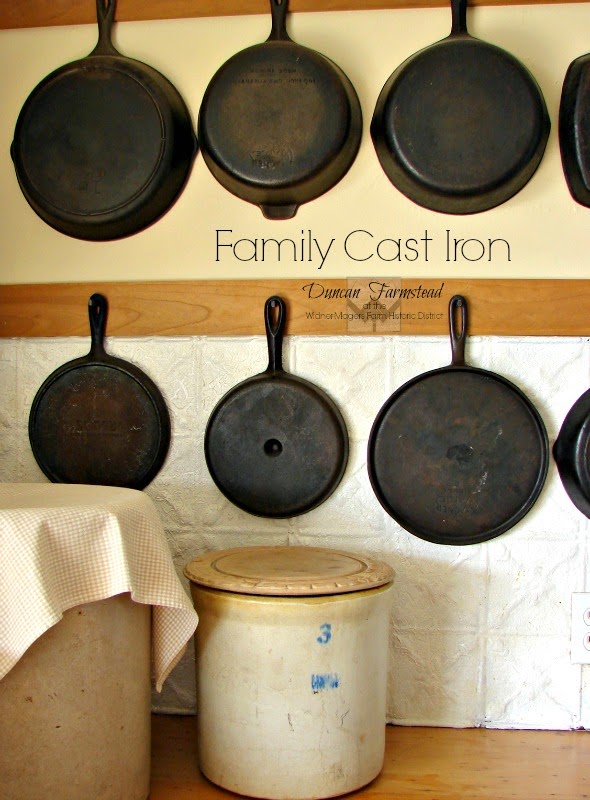
I've been very blessed to have acquired a family collection of coveted iron cookware pieces. . .One entire wall of my farmhouse kitchen is filled with skillets, griddles, and 'chicken fryers' from both my Grandmothers, my Mom, my two Aunts, and myself. . .Every piece has a story. . .Every piece has a purpose. . .And any Delta cook will tell you that no new, expensive shiny cookware on the market will give you the flavor that comes from a cast iron piece. . .I'm convinced that it's one reason there were--and are--so many super Delta cooks.

Good flavor depends on proper seasoning of the cast iron. There's nothing worse than a dish cooked in a sticky, gummy improperly seasoned piece of cookware. Nothing. I know because in my younger, less-informed years I owned a few really bad ones myself. It didn't take me long to seek out an expert on proper seasoning and care of the precious as gold cast iron.

When you purchase cast iron, it will be a medium gray in color. It will have to be seasoned first thing out of the box. Seasoning is the process of applying layers of lard or grease to a new iron piece in order to create a nonstick surface. The process not only keeps food from adhering to the inside of the pan but it also imparts a rich, unique flavor to whatever the recipe. This is why regular cookware can't compare--the FLAVOR just isn't there.


SEASONING YOUR CAST IRON COOKWARE
1. Heat the oven to 250-300 degrees
2. Coat the pan with lard or bacon grease. Do not use liquid oil. It will leave a sticky mess.
3. Place pan in the oven for 15 minutes. Remove and pour off excess grease. Replace into the oven and bake for at least 2 hours. 
4. Repeat the process several times for a well-seasoned pan.
5. To enhance the seasoning process, initially use the pot or skillet for frying foods high in fat, such as bacon or deep-fried chicken.

Once you begin cooking with the cast iron, treat it with a little bit of tender loving care.
*Never store food in cast-iron. The food will take over a metallic taste but worst than that, you're well-seasoned pot will lose it's seasoning as acids from the food are absorbed.
*Clean the cookware while it is still warm with warm water, scraping out any food. 
*Never use cold water on a hot pot.
*Never use a scouring pad or soap.
*Never put the cookware in a dishwasher. (Heaven forbid!)
*A quick re-seasoning each time the cookware is used will keep it non-stick and rust free. Simply place on a stove burner on the lowest setting. This will open up the pores of the skillet or pot. Once it is warm--but NOT hot--smear a very thin coat of bacon grease or lard over the inside surface. Turn off burner. Do not remove the cookware until it has cooled. Wipe out any excess grease with a paper towel.
*If your cast-iron cookware begins to rust, the seasoning process will again be necessary.

Over time, you'll learn which pieces fit your personal style of cooking best. I have a use for each of the pieces on my family wall. . .


If you're lucky enough to own a few pieces of cast iron, get them out and use them. . .They only get better with use. . .and I promise you that your food will take on a simply amazing flavor. . .


LIFE IS GOOD. . .


Tuesday, January 13, 2015

Farm Story Published in the Courier News


Thought a little history background might be the way to begin the year 2015. . . 

Local history celebrated at area farm


When she was growing up as part of a farming family in Dell, Dru Duncan dreamed of moving away from the flatlands of Mississippi County. Yet, after having made a life for herself elsewhere, cotton farming country is exactly where she ended up settling. Dru and her husband, John Holt, met in Colonial Williamsburg, where they were both working as historical re-enactors. Following her choice to end a long career in cytotechnology and a recent divorce, Dru had come to Williamsburg for a job in the place where she had wanted to work since she visited there as a child. John had also been married and divorced, and had left his job with an architectural firm to begin trying to get work as a re-enactor, and was finally building a career as a self-taught historical storyteller, auctioneer and even actor in period movies such as "Cold Mountain" and "New World."
Shortly after the two met, Dru's parents fell into ill health, and after the loss of her mother, the couple found themselves traveling back to Dell to care for her ailing father.
According to John, it took almost no time for him to "fall in love with this land."
"When we crossed the bridge in Memphis headed into Mississippi County," he said, "that was it. I looked at all this open land, all the agriculture -- and I just fell in love. It smells different here -- so open and I can just smell that soil. I never wanted to leave."
The farm that Dru's family had built from the ground up in the 1930s was still operational, but many of the old buildings were in disrepair, and Dru shared her desire with John to restore the place to its original working glory.
The couple decided to end their work in Colonial Williamsburg, and John came to help Dru care for her father in the final nine months of his life. During that time, they learned as much as they could about the history of the farm and how it ran in the days when it was just beginning.
The next seven years were spent in constant work. Mostly on their own, Dru and John repaired, restored, and breathed life back into all of the buildings which sat on Dru's family land. With the knowledge that they gained as professional historical re-enactors in Williamsburg, they collected donations of antique items and have created the Widner-Magers Farm Historic District, a living look back into a Delta cotton farm in 1938.
"We want to teach people, mainly children, what farming was like, how it was the lifeline of this part of the country for so many years," said Dru. "I remember shotgun houses and outhouses -- this was how people lived."
Featuring several shotgun houses that the couple are working to turn into a B&B, or "bed and barbecue," a craftsman style tenant house, a period farm manager's home, the Widner and Magers barns, a farm shop, a corn crib, and other outbuildings, even a "company store" with a historical post office and other artifacts, the farm shows visitors exactly how their ancestors in the Delta would have lived the agricultural life.
Dru and John greet visitors on Thursdays, Fridays, and Saturdays, wearing 1938 period clothing and in character as a period farming couple. Guests are then given a tour as if the farm were really working in the post-depression era.
Special demonstrations are scheduled throughout the fall on Saturdays, wherein the couple demonstrates their talents and shares things that made the 1930s farming way of life unique. Upcoming demonstration days include:
-- Oct. 22: Rag rug weaving
-- Oct. 29: Native American storytelling
-- Nov. 5: Sewing with a treadle
-- Nov. 19: Delta Utility Quilts
-- Nov. 26: Cooking pumpkin butter
The couple has also partnered with Arkansas Northeastern College to offer several noncredit courses on things like open hearth cooking and professional archeology digging.
"We want children in this area to understand that history is living," said Dru. "When I touch the old boards in these buildings, someone else touched them, someone that had a life here just like I do. This farm is also an example that every person has a hidden talent, and if you have a passion for something, you can make it happen."
Courier News, Friday October 14, 2011

It's an older article but full of details about our dream for the farm. . .Schedules and workshops change each year and will be updated as necessary at: DUNCAN FARMSTEAD

We do have our internet back. . .Looks as if it might stay on for a while. . .Winter is definitely here. . .The cold north winds are howling. . .We are working on a few indoor projects that I'll be sharing soon. . .Til then. . .Remember. . .LIFE IS GOOD. . .

Tuesday, December 23, 2014

It's Christmas. . .So. . .

 
BLESSINGS TO ALL. . .
and a quick note to let you know. . .
our internet has been down for weeks. . .but. . .
we'll be back with more farm happenings next year. . .
SEE YOU THEN!


Friday, November 14, 2014

Circa 1825


I've had so many questions from visitors--as well as online--about our plans for the oldest structure on the farmstead. . .The Everett-Short log home is actually one of our favorite projects. . .Dated 1825, it's almost 200 years old. . .Once completed, we'll have the perfect place to interpret local 19th century history. . .In 1823, William Hector moved his family living in  Missouri to a log house built on an ancient Indian mound just east of Big Lake and close to present-day Dell. . .They were of Native American blood but living as whites. . .William knew the area well. . .It had been the hunting grounds of his people for many years. . .When Missouri made it unlawful for Native Americans to live in their state, the Hectors decided to move to Arkansas. . .The land was swampy and dark from the heavy forests and no drainage. . .but it was here that they made their life and were joined by others as the US government relocated thousands of Native Americans to Oklahoma. . .In the 1830 US Census, William states that he had numerous slaves under his roof, when in fact, he was hiding many who were able to break away from the Trail of Tears. Escaping from boats on the Mississippi River, officials weren't keen on chasing them into such rugged country. Most were able to hide for years. Many families today are descended from those Native Americans. 
 
Everett-Short Dog Trot Log House, 2009


The logs are salvaged, enough to reconstruct one pen at the Duncan Farmstead
 
 
The right pen reconstructed at the Duncan Farmstead
 
Log housing was a part of our Delta history for another 100 years. Most Dell residents do not realize that many homes at the turn of the 20th century were of logs. Vast forests covered the area, so it was only natural that the houses were constructed of materials at hand. Early pioneer log homes such as the Hectors were also available.  When my grandparents Earl and Alice Magers came to Dell in 1916, they moved into an existing dogtrot style log house north of Dell, close to the old Mooney Cemetery. Mamie Magers Griffin remembered the house well. One side of the dogtrot was the hub of their family life. It was heated with a large fireplace. Food was prepared in the room and most family activities took place there. When it came time for bed, the entire family slept in the second side of the dogtrot. A fire in the smaller fireplace helped keep them warm and cozy at the beginning of their slumber. But, by morning, the fire was gone. As long as she and her sister, Naoma, remained in bed, all was fine. But, once those little feet touched the cold floor, neither of them wasted time running to the kitchen where breakfast was being prepared. . .During the hot, humid summers, all the windows and doors were left open. Much of the housekeeping work was done on the central open porch between the two rooms. Churning butter, cleaning vegetables, canning and many other tasks were carried on outside of the hot rooms. "If there was any breeze at all, the porch was the coolest place to be." (Aunt Mamie, 2002)
 
 
The Everett-Short structure comes to us with it's own history. Originally located in Prim, AR it was a two pen dogtrot style--such as the one the Magers family moved into at Dell. The walls were constructed of hand-hewn logs. The Fransus M. Everett family lived there for many years. When Shirley's father (Everett's son) took over the farm, he turned the home into a barn for his livestock. Eventually, Shirley Everett Short inherited the farm. Over the years, the barn was abandoned. It sat silently deteriorating as time went by. The Shorts then faced the hard decision of a high cost restoration or a demolition of a part of their family history. The Rural Arkansas Magazine article presented them with a third choice--the one that brought Dave and Shirley to the Duncan Farmstead one hot August day with the offer of a donation of their historic structure.
 
While the deterioration was too extensive to move and reconstruct the home as it was originally built, plenty of the logs were salvaged for a single pen structure.
 
 
Now located at the Duncan Farmstead, the Everett-Short log home will serve as a lasting legacy from the descendants of Fransus M. Everett (Shirley's grandfather) but will also be a tribute to the pioneer settlers of our own early Delta history. . . We have such a rich history that few know. . . .Thanks to Shirley and Dave Short. . .John and I now have the opportunity to tell the story.
 

You'll find more stories, links and photos of the original building and it's move to Dell at the DUNCAN FARMSTEAD WEBSITE. . .There you'll also see what a long way we've come.
 
We've been very blessed with interest and donations for our living history museum and wish to thank everyone for their contributions--large or small. . .We consider them all a legacy left for future generations. . .a legacy that won't be lost. . .LIFE IS GOOD. . .isn't it?


Thursday, October 30, 2014

Inside the Company Store: Post a Letter or Make a Deal


During the Depression Era, the Company Store was the place of much activity. . .Here sharecroppers and tenants bought (usually on credit) their seeds and supplies. . . shopped for food and clothing. . .posted a letter or received their order from Sears Roebuck and Company. . .made contracts for farmland. . .to sharecrop or to rent acreage. . .It's the place where everyone met to talk about the crops or hear the latest gossip. . .Notices were posted. . .The latest news was heard on the radio. . .

It's not much different at the Duncan Farmstead today. . .It's the place our groups gather. . .Purchase their candy and other items. . .Learn more information about the Depression Era. . .Maybe get a lesson in Rag Rug Weaving. . .As the Company Store was, it still is. . .The HEART of the farmstead.


The Company Store might also house the Farm Manager's Office. . .Here the farmers met with the 'boss man'--discussing the terms of the sharecropping or tenant contract and the line of credit they needed to carry them and their families through the season. . .until crops were harvested and sold. . .This was called 'the furnish'. . .The manager or land owner sold the crop that the farmers tended and harvested during the year. . .Then they'd meet back in the office to 'settle up'. . .(SEE: Sharecroppers and Tenants ) . . .


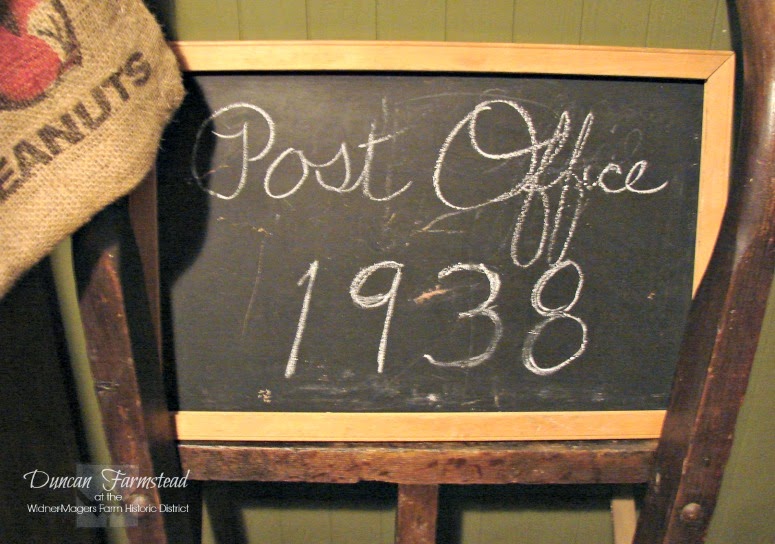
We have Marguerite Brownlee of Dell to thank for our Company Store Post Office. . .She was Postmaster in Dell for many, many years. . .When that facility was up-graded, she had the foresight to store this original Dell Post Office so that it didn't end up in the dump. . .She saved the rent boxes. . .the cage. . .the cubby holes. . .the scales. . .the tables. . .and numerous other Postal Service items. . . They sat in the storage room for many years at Brownlee's Store on Main Street in Dell, waiting for the day to be seen again. . .and that day came a few years ago when the Brownlee Store building had to razed. . .What a surprise it was when Mrs. Brownlee and her family generously offered the vintage Post Office to us. . .We were working on the interior of the Company Store. . .not sure how we'd come up with the displays we needed. . .Of course, we jumped at the chance--knowing that many country and company stores housed the community post office. . .We were so grateful for the opportunity.

 
Other vintage items came from donations and family. . .The Aladin's Lamp was donated by Bobby Hogan. . .The Mule Collar Mirror by Joe Chipman. . .Postal Stamps by Don Davis who also worked for the Post Office in another town. . .The office desk served my Grandmother Duncan for years. . .and Daddy after that. . .His vintage Underwood typewriter sits there. . .It was Daddy's first and last typewriter. . .He never up-graded and used it everyday. . .He said a new one--or a computer--wouldn't know what he wanted to say. . .The drawers still store his office supplies, tapes, and files. . .just as he left them. . .


The 1938 Desk Diary was my Granddaddy's (Earl Magers). . .and the ledgers were found stored in a barn at my parents home. . .


It has taken us years to gather everything and display it for our visitors to enjoy. . .It's been a monumental task. . .but I think it's finally done. . .Now it's time to sit back and enjoy telling the old stories. . .and welcome visitors as they participate in a piece of Delta history.

It's also the place I go to manage our farmstead. . .A place to open mail. . .pay bills. . .enter receipts in the ledger. . .correspond with others. . .The old radio still plays gospel music each morning. . .with news and updates every hour. . .Not so very different from 80+ years ago. . .A simple but busy life style. . .As it was. . .and as it is. . .
LIFE IS GOOD. . .

 
Post Script: My apologies for poor quality of the photos. . .For some reason, it is very difficult to photograph the back office and postal area. . .I suppose there's not enough light?. . .To our 21st century eyes, the colors seem rather dark and forbidding at times. . .but this isn't 2014. . .Nope. . .It's 1938. . .and 'just the way it was'. . .All the newest and best. during the Depression Era.